Madison County Dog Registration Information
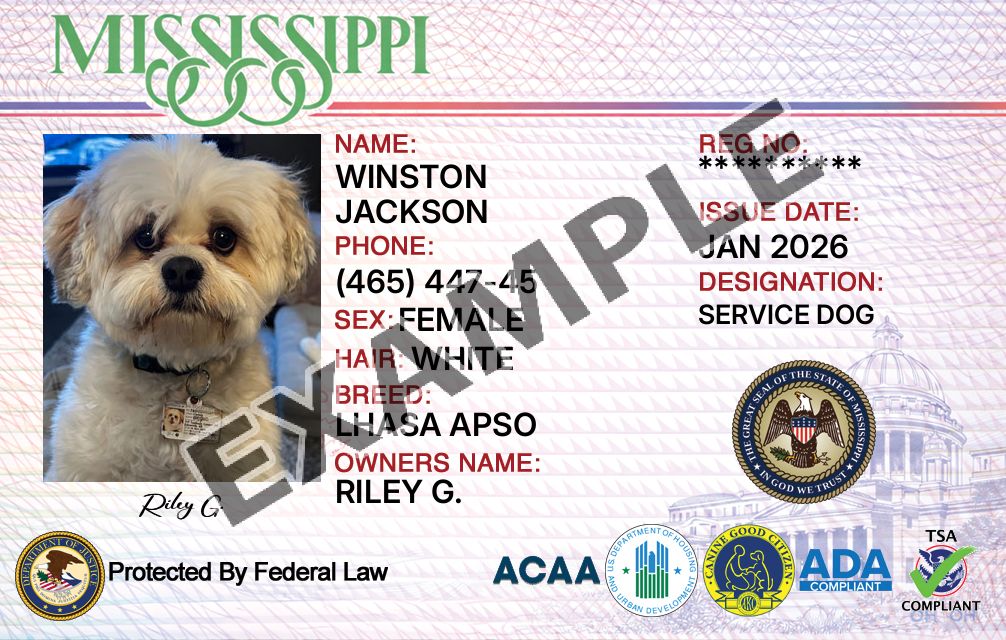
Service Dogs and Emotional Support Animals in Madison, Mississippi
If you’re asking, “where do I register my dog in Madison County, Mississippi for my service dog or emotional support dog,” the answer depends on where you live inside the county (for example, inside the City of Madison or the City of Ridgeland versus an unincorporated area). In most cases, what people mean by “registering” is obtaining a local dog license in Madison County, Mississippi (often tied to rabies vaccination compliance), not a separate service dog or emotional support dog registry.
Where to Register or License Your Dog in Madison County, Mississippi
The offices below are official city agencies that handle animal control services and are commonly the right starting point for questions about an animal control dog license in Madison County, Mississippi, leash laws, and local procedures. If you live in an unincorporated part of Madison County (outside city limits), you may need to contact county-level animal services through the Sheriff’s Office; if licensing details for your specific address are not clear, call the most relevant office below and ask which agency issues licenses for your jurisdiction.
Madison Police Department (Animal Control & Rescue Services) — City of Madison
- Phone: (601) 856-6111
- Emergency: 911
- Municipal Court: (601) 707-1412
- Note: City web materials describe Animal Control as part of the Madison Police Department and provide this contact for animal control assistance.
Ridgeland Police Department / Animal Control — City of Ridgeland
- Non-emergency dispatch (includes animal control calls): (601) 856-2121
- Email: animalcontrol@ridgelandms.org
- Routine animal control working hours: 6:00 a.m. to 6:00 p.m. daily (calls for missing, injured, or dangerous animals may be taken anytime)
- Note: City materials list the animal control contact email and indicate routine working hours; dispatch is used for animal control-related calls.
Madison County Sheriff’s Department (General Contact) — Madison County
- Phone: (601) 859-2345
- Note: This is a verified general contact for the Sheriff’s Department. If you live outside city limits or you’re unsure which agency provides animal services for your address, ask to be directed to the appropriate county animal services/animal control resource.
Overview of Dog Licensing in Madison County, Mississippi
What “dog registration” typically means locally
In everyday conversation, “registering a dog” usually means getting a local dog license and keeping required tags on your dog’s collar (commonly a rabies tag and/or a local license tag). Dog licensing is typically a local government process (city or county), and requirements may vary depending on whether you live inside a city boundary or in an unincorporated part of the county.
Rabies vaccination is a common baseline requirement
Many Mississippi localities tie licensing to proof of current rabies vaccination. As a statewide baseline, Mississippi law requires dogs and cats (3 months and older) to be vaccinated against rabies, and the law discusses the use of collars/tags associated with rabies vaccination compliance.
Service dog or ESA status does not replace local licensing
Even when a dog is a service dog or an emotional support animal, local licensing rules (such as rabies vaccination documentation and local tag requirements) can still apply. In other words, service dog status is about disability access rights; dog licensing is about local animal control administration and public health.
What You Need Before Registering a Dog
Typical documents and information requested
While dog licensing requirements in Madison County, Mississippi can vary by jurisdiction, these are commonly requested items when applying for a dog license or updating your information:
- Proof of current rabies vaccination (certificate and/or rabies tag information)
- Your address (to confirm whether you’re within a city limit or in the county)
- Your photo ID (often requested for in-person transactions)
- Dog description (breed, color/markings, age, sex)
- Spay/neuter documentation (if your jurisdiction uses different fees or license types)
If you are licensing a newly acquired dog
If you recently moved to Madison County or recently adopted a dog, you may be asked to provide the date you acquired the animal and current contact information. If you’re unsure where to start, call the relevant city animal control contact (Madison or Ridgeland) or the Sheriff’s Department for guidance on where to register a dog in Madison County, Mississippi based on your specific address.
Steps to Register or License a Dog in Madison County, Mississippi
Step 1: Confirm your jurisdiction (city vs. county)
The first step is determining whether your home is:
- Inside a city (such as Madison or Ridgeland), where city animal control and city ordinances often apply, or
- In an unincorporated area of Madison County, where county resources may be your starting point.
Step 2: Gather vaccination proof and any required documents
Have your dog’s rabies vaccination certificate available, along with identification and any spay/neuter paperwork if applicable. If you have an updated rabies shot but lost the tag/certificate, contact the veterinary clinic that administered the vaccine to request a replacement record.
Step 3: Contact the appropriate office and ask about the local license process
Because procedures can be city-specific, call the office that serves your address and ask:
- Whether a dog license is required for your residence address
- What documents are required and whether they accept copies
- Whether you receive a local tag and how renewals work
- Whether service dogs have any local fee exemptions (if any) and what proof is required (if applicable)
Step 4: Keep tags current and accessible
Once licensed (if required in your jurisdiction), keep your dog’s rabies tag and any local license tag on the collar as instructed. This is helpful for public health compliance and can speed up reunification if the dog is lost.
Service Dog Laws in Madison County, Mississippi
What makes a dog a “service dog” (ADA)
Under the ADA, a service animal is generally a dog that is individually trained to do work or perform tasks for a person with a disability. The ADA framework is federal and applies in Madison County, Mississippi the same way it applies elsewhere in the United States.
No universal federal “registration” or certificate required
People often search for a service dog registry, but the U.S. Department of Justice notes that documents or certificates sold or offered online are not recognized by DOJ as proof that a dog is a service animal. Businesses generally may ask limited questions when the service the dog provides is not obvious, but they typically cannot require documentation as a condition of entry.
Local dog licensing still may apply
A service dog can still be subject to local animal rules such as rabies vaccination requirements and, where applicable, city/county dog licensing. Service dog status addresses access rights; it does not automatically replace local public health and animal control requirements.
| Category | Purpose | Where it applies | Typical proof |
|---|---|---|---|
| Dog license | Local animal control/public health compliance (often linked to rabies vaccination and identification) | City or county jurisdiction (rules can vary within Madison County) | Rabies vaccination record; possibly spay/neuter documentation; owner contact details |
| Service dog | Disability access: dog trained to perform tasks for a person with a disability | Public accommodations and many government settings under federal ADA rules | No universal federal registry; generally not documentation-based for public access |
| Emotional support animal (ESA) | Provides emotional support that alleviates one or more effects of a disability (commonly housing context) | Often addressed under housing-related rules rather than public-access rules | Commonly disability-related documentation for housing requests (not a public-access credential) |
Emotional Support Animal Rules in Madison County, Mississippi
ESAs are not the same as service dogs
An emotional support animal is different from a service dog. ESAs generally are not granted the same broad public-access rights as service dogs under the ADA. In practice, ESAs are most often discussed in the context of housing accommodations rather than entry into stores, restaurants, or other public accommodations.
Local licensing and rabies rules still matter
Even if your dog is an ESA, you may still need to meet local requirements such as keeping rabies vaccination current and obtaining a local dog license if required by your municipality.
If you rent: ask about the housing process (separate from licensing)
If your main concern is landlord paperwork, keep the concepts separate: (1) local dog licensing (animal control/public health) and (2) housing accommodation requests (ESA documentation). If needed, you can contact your local animal control office (above) for licensing questions and handle housing accommodation requests through your housing provider’s standard process.
Frequently Asked Questions
Typically, no. There is no one universal federal government registry for service dogs or emotional support animals. What you may need (depending on where you live) is a local dog license and proof of rabies vaccination. Service dog status is based on training to perform tasks for a disability under ADA rules; ESA status is most often relevant to housing accommodations.
Start by calling the office most likely tied to your address:
- If you live in the City of Madison, contact Madison Police Department (Animal Control & Rescue Services).
- If you live in the City of Ridgeland, contact Ridgeland dispatch and ask for Animal Control.
- If you live in an unincorporated area, call the Madison County Sheriff’s Department and ask where dog licensing and animal control services are handled for your area.
Requirements vary by jurisdiction, but commonly include:
- Proof of current rabies vaccination
- Owner ID and contact info
- Address/residency info (to confirm jurisdiction)
- Spay/neuter documentation (if applicable)
- Payment for any required fee (if your jurisdiction has one)
In general, ADA guidance indicates that documents and certificates are not recognized by the U.S. Department of Justice as proof that a dog is a service animal. Service dog access is not based on purchasing a registry listing. However, local dog licensing (rabies compliance and local tags, where applicable) is a separate matter from ADA service animal status.
It can. Cities may have their own animal control ordinances, processes, and contact points. That’s why “where do I register my dog in Madison County, Mississippi” depends on whether you live inside a city boundary (such as Madison or Ridgeland) or in an unincorporated area of the county. When in doubt, call the office listed above for your city (or the Sheriff’s Department for county areas) and confirm the current licensing steps.
Register A Dog In Other Mississippi Counties
Select your county below to get started with your dog’s ID card. Requirements and license designs may vary by county, so choose your location to see the correct options and complete your pup’s registration.
- Adams County Dog Registration
- Alcorn County Dog Registration
- Amite County Dog Registration
- Attala County Dog Registration
- Benton County Dog Registration
- Bolivar County Dog Registration
- Calhoun County Dog Registration
- Carroll County Dog Registration
- Chickasaw County Dog Registration
- Choctaw County Dog Registration
- Claiborne County Dog Registration
- Clarke County Dog Registration
- Clay County Dog Registration
- Coahoma County Dog Registration
- Copiah County Dog Registration
- Covington County Dog Registration
- DeSoto County Dog Registration
- Forrest County Dog Registration
- Franklin County Dog Registration
- George County Dog Registration
- Greene County Dog Registration
- Grenada County Dog Registration
- Hancock County Dog Registration
- Harrison County Dog Registration
- Hinds County Dog Registration
- Holmes County Dog Registration
- Humphreys County Dog Registration
- Issaquena County Dog Registration
- Itawamba County Dog Registration
- Jackson County Dog Registration
- Jasper County Dog Registration
- Jefferson County Dog Registration
- Jefferson Davis County Dog Registration
- Jones County Dog Registration
- Kemper County Dog Registration
- Lafayette County Dog Registration
- Lamar County Dog Registration
- Lauderdale County Dog Registration
- Lawrence County Dog Registration
- Leake County Dog Registration
- Lee County Dog Registration
- Leflore County Dog Registration
- Lincoln County Dog Registration
- Lowndes County Dog Registration
- Marion County Dog Registration
- Marshall County Dog Registration
- Monroe County Dog Registration
- Montgomery County Dog Registration
- Neshoba County Dog Registration
- Newton County Dog Registration
- Noxubee County Dog Registration
- Oktibbeha County Dog Registration
- Panola County Dog Registration
- Pearl River County Dog Registration
- Perry County Dog Registration
- Pike County Dog Registration
- Pontotoc County Dog Registration
- Prentiss County Dog Registration
- Quitman County Dog Registration
- Rankin County Dog Registration
- Scott County Dog Registration
- Sharkey County Dog Registration
- Simpson County Dog Registration
- Smith County Dog Registration
- Stone County Dog Registration
- Sunflower County Dog Registration
- Tallahatchie County Dog Registration
- Tate County Dog Registration
- Tippah County Dog Registration
- Tishomingo County Dog Registration
- Tunica County Dog Registration
- Union County Dog Registration
- Walthall County Dog Registration
- Warren County Dog Registration
- Washington County Dog Registration
- Wayne County Dog Registration
- Webster County Dog Registration
- Wilkinson County Dog Registration
- Winston County Dog Registration
- Yalobusha County Dog Registration
- Yazoo County Dog Registration